
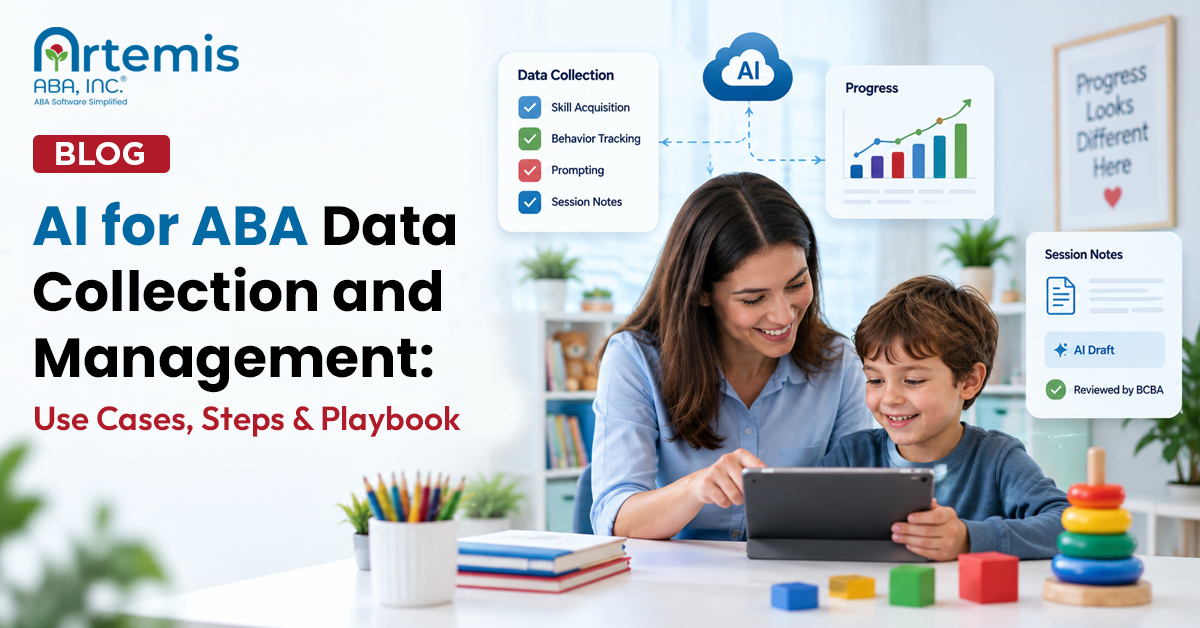
AI for ABA Data Collection and Management: Use Cases, Steps & Playbook

Inside this article:

AI creates efficiencies and challenges for ABA data collection and management. Explore current and emerging AI use cases, tool types, implementation steps, and AI’s future for ABA data. Get an AI playbook for ABA clinics, and take our readiness quiz.
[fs-toc-omit]How AI Changes ABA Data Collection and Data Management Workflow
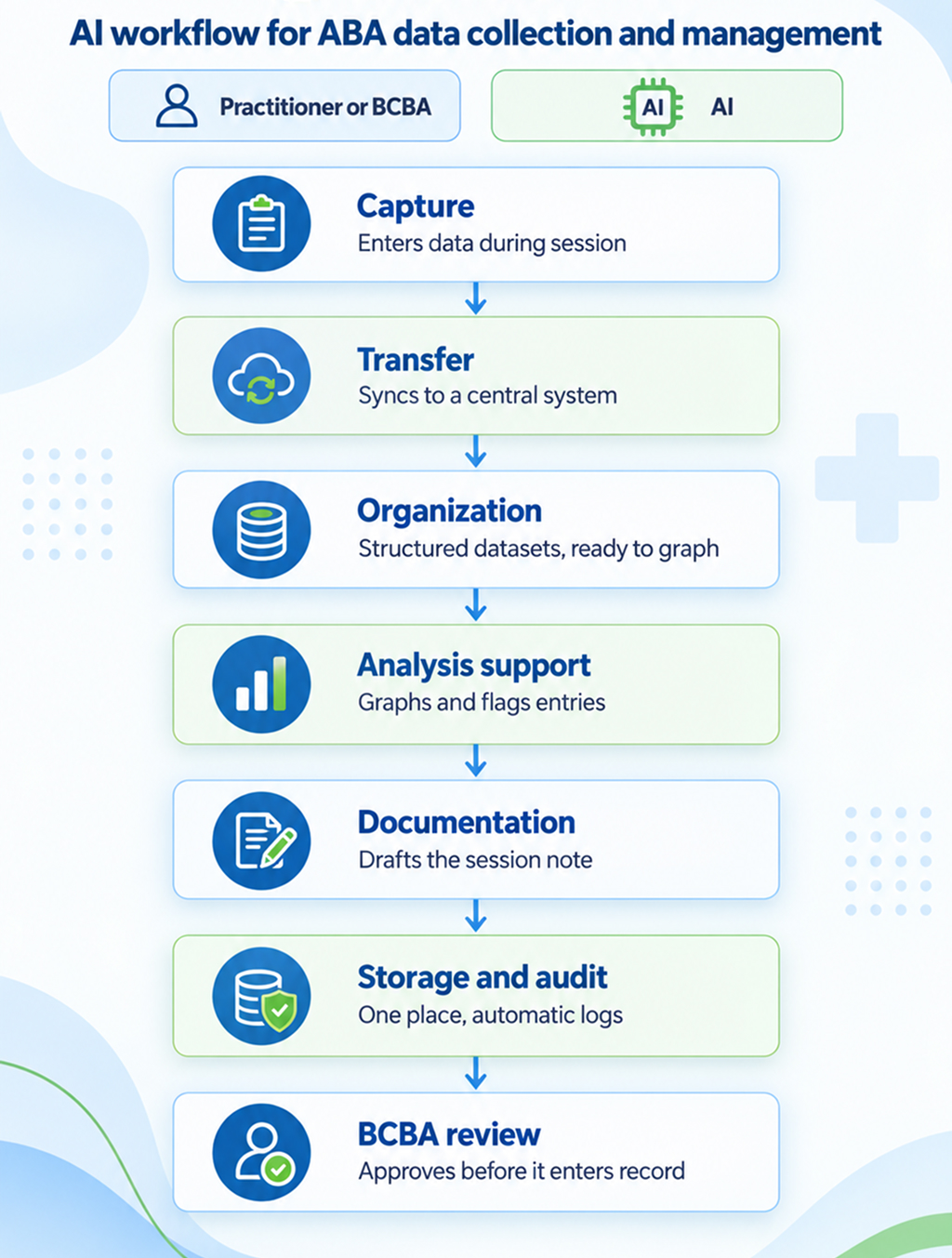
AI changes ABA data collection and management by automating the mechanical steps and leaving clinical judgment to the BCBA. Practitioners capture data on one screen. AI syncs, organizes, graphs, and drafts notes from those entries. The BCBA interprets, and every AI output is checked before it enters the record.
In a traditional setup, collection and management are separate manual tasks. A technician records raw data on paper or a basic app during the session. Someone transfers it, graphs it by hand or semi-manually, and writes the session note later from memory and the datasheet. The data, the graph, and the note often live in different places.
With AI in the workflow, those same stages connect, and most manual handoffs disappear. What changes at each stage:
- Capture: Practitioners enter structured data from a single screen during the session. Timestamps are automatic. Offline capture holds data during home or low-signal sessions and syncs on reconnection.
- Transfer: Entries sync automatically to a central system instead of being re-keyed later.
- Organization: Data lands in structured datasets rather than scattered sheets, so it is ready to graph and query.
- Analysis support: Graphs generate as data comes in, and the system can surface entries that need a second look. Interpretation stays with the BCBA.
- Documentation: Natural language processing converts trial-based data into a narrative session note, which the clinician vets for accuracy before finalizing. The Practice Parameters' glossary uses this exact workflow as its example of natural language processing in ABA.
- Storage and audit: Records sit in one place with automatic access logs, which supports audit trails and payer review.
The Council of Autism Service Providers (CASP) gives direct guidance about using AI in “Practice Parameters for Artificial Intelligence Use in Applied Behavior Analysis,” saying, “AI should serve as a tool to support clinical work, not supplant it."
Regan Hatwig, BCBA and Clinical Implementation Leader at Artemis ABA, says AI is most helpful when a clinician is still responsible for collecting and validating the data, while the technology assists with organization, summarization, and documentation.

“In my experience, AI is highly useful for transforming raw data, notes, or bullet points into structured narratives, progress summaries, and treatment plan drafts,” she says. “Where I do not fully trust AI is in interpreting clinical data or making independent clinical decisions. Any AI-generated note, graph, treatment plan, or report should be reviewed, edited, and approved by a qualified clinician before being finalized. I view AI as a support tool rather than a replacement for clinical judgment.”
Use Cases for AI-powered Data Management
The main AI use cases in ABA data management (vs. collection) are real-time data integration, automated graphing, and data-to-note conversion. Real-time entry and automated graphs are commercially standard in 2026, and AI-drafted session notes are the most mature AI feature. In each, AI organizes the data and the BCBA interprets it.
These are the most established uses of AI in ABA data work, which is why they're being covered before the emerging, collection-side tools.
Real-Time Data Integration
Real-time data integration means data entered during a session syncs immediately to a central system, so the whole team can see it without manual transfer. Practitioners enter data digitally. Offline capture holds entries during home or low-signal sessions and syncs when the connection returns.
Live dashboards update as data comes in, which lets a supervisor check progress without waiting for a weekly export.
Automated Graphing
Automated graphing generates progress graphs as data is entered, which replaces manual or semi-manual charting. Graphs update in real time and can show phase change lines, milestone markers, and trend lines. A supervisor can spot a pattern the day it appears instead of at the next review. Automated graphing is commercially standard.
Interpreting the graph is the part that stays with the BCBA. Software that analyzes single-case graphs on its own is still a research area, so today the tool draws the graph, and the clinician reads it.
Data-to-Note Conversion
Data-to-note conversion uses natural language processing to turn trial-based session data into a narrative note, which the clinician reviews for accuracy before signing. It is the most mature AI feature in ABA data tools.
The Practice Parameters describe this exact process in their definition of natural language processing: a clinician records trial-based data, an algorithm converts it into narrative session notes, and the clinician vets the notes for accuracy.
“I specifically look for hallucinations, unsupported conclusions, or instances where the AI has elaborated beyond the information it was provided,” Hatwig says.
For a deeper walkthrough, see our guides on using AI for ABA session notes and using AI for SOAP notes.
Other Data Management Use Cases
Beyond the three above, several data-management uses are supported by current research and appear in some tools:
- Documentation auditing. An auditing tool can check whether clinical documentation supports medical necessity. The Practice Parameters name this as one reason a practice might select an AI tool, which ties directly to payer review.
- Data quality checks. AI can flag missing sessions, out-of-range entries, and inconsistent operational definitions for human review. This is grounded in the Practice Parameters' monitoring guidance on thresholds and discrepancy review.
- Instant interobserver agreement. Once two observers' data streams are digital, software can compute IOA across them at once. "Getting more from your IOA data: Alternative measures to total, occurrence, and non-occurrence agreement" reflects the field expansion of computational analysis of agreement data.
- Procedural fidelity support. "Supporting procedural fidelity of behavioral interventions for children with autism via an artificial intelligence platform" tested an AI platform for this use, which connects to treatment integrity.
- Clinical decision support. In healthcare broadly, a system may suggest a treatment plan change when data show a target behavior is not improving. This is emerging in ABA, not standard, and any claim that a specific platform does it should be verified against that platform's documentation.
- Transcript-to-task tracking. AI can search session or meeting transcripts and pull out follow-up items, turning them into a per-client to-do list, so a clinician can track what they committed to for each client.
Emerging Use Cases for AI-powered ABA Data Collection
Emerging AI uses for ABA data collection (vs. data management) center on automated interpretation: computer vision that scores behavior from video, machine learning that predicts behavior from wearable sensors, and audio analysis of vocal behavior. The AI that reads sensor and video output automatically is still at the research stage.
Cameras and wearables have been on the market for a decade. What is emerging is the AI layer that scores their output without a human in the loop. That work comes from research programs, inpatient settings, and feasibility studies, and it is not a validated, standard tool for everyday ABA session documentation yet.
Computer Vision and Automated Video Analysis
Computer vision analyzes session video to detect and classify behaviors such as stereotypy (repetitive movement) or self-injury. It is an active research area, not a standard clinical tool. The aim is to score behavior automatically from recorded video, and the main limitation is how little training data exists.
"Automated Analysis of Stereotypical Movements in Videos of Children With Autism Spectrum Disorder," published in JAMA Network Open in 2024, describes how an algorithm scans long assessment recordings and picks out varied stereotyped movements, going beyond the few preset movement types earlier models could handle. It is a real advance, but the datasets used to train these models are still small, too small to generalize to the full range of behavior in a real session. Research is extending the same approach to self-injurious behavior.
Biometric Wearable and Sensor Integration
Biometric prediction applies machine learning to wrist sensors that track heart activity, skin response, and motion, to forecast behaviors such as aggression before they happen. This work has been done mainly in inpatient psychiatric settings. It is predictive research, not a standard data-collection method for ABA clinics.
Early work established that a wrist biosensor recording cardiovascular activity, electrodermal activity, and motion could predict aggression shortly before it occurred. A larger replication followed. "Wearable Biosensing to Predict Imminent Aggressive Behavior in Psychiatric Inpatient Youths With Autism," published in JAMA Network Open in 2023, studied 70 inpatient youths across four psychiatric hospitals and predicted aggressive behavior three minutes before it occurred, with a mean AUROC of 0.80, a measure of how well the model separated the two outcomes.
More recent work pushes into new dimensions. "Using wearable sensors to measure frequency and force of dangerous behaviors: An exploratory study of feasibility," from 2025, is notable because force is something human observers cannot score reliably by eye. The article "Feasibility of forecasting self-injurious behavior among autistic youth using wearable sensors and machine learning models," published in Scientific Reports in 2026, forecasts self-injury and reported better performance at longer forecast horizons. Both are framed as feasibility work.
Some clinicians are already using consumer wearables and cameras in their practices, but mainly for supplementary insight. What remains at the research stage is validated, automated scoring that would let these devices produce the data of record.

Bethany Coop, BCBA, Clinical Manager of Telehealth Services for Step-In Autism Services, has used them in her clinic since early devices came on the market.
"I love wearables and began using them in my clinic when the first stress detector button and mini-cameras came out," Coop says. "They aren't a catch-all, but can provide some valuable data and insights when working with clients. The important thing to remember is that there are a lot of confounding variables impacting the accuracy of the data."
Hatwig sees the significant potential in wearables and video-assisted data collection, but also advises caution. “They can reduce documentation burden and allow clinicians to remain more engaged with clients. However, I believe best practice is for the provider to regularly verify the data throughout the session, ideally after trial sets or short observation periods, rather than waiting until the end.”
Audio Analysis
Audio analysis uses AI to measure vocal behaviors such as vocal stereotypy from recorded sound. It is early-stage research. "Artificial intelligence for the measurement of vocal stereotypy," published in 2020, is the anchor study for this approach in behavior analysis.
These approaches share the same open questions. The datasets are small, most results come from specialized or research settings, and consent, privacy, and validation have to be worked out before any of this becomes routine clinical practice. For now, they show where automated data collection may be heading, not what it does today.
[fs-toc-omit]How ABA Measurements Can Change With AI-assisted Data Collection and Management
AI-assisted data collection changes ABA measurement in two ways. For standard measures like frequency, duration, and IOA, it changes how data is captured and computed, not the measures themselves. At the emerging edge, sensors can measure dimensions humans struggle to score, such as the force of dangerous behavior.
The definitions of the measures do not change. Frequency, duration, and interobserver agreement mean what they always have. What changes for these is the work around them. Digital capture with timestamps replaces paper sheets and stopwatches, and the software calculates as data comes in. The team sees running totals during the session instead of tallying at the end of the week, and transcription and arithmetic errors drop.
AI can also enable measurements that are hard to do by hand. In "Using Wearable Sensors to Measure Frequency and Force of Dangerous Behaviors," wearable inertial sensors measured the force of dangerous behavior, a dimension human observers cannot score reliably by eye. The study was exploratory, and the force testing used neurotypical children simulating the behavior, so this is a feasibility finding, not a standard clinic tool.
For now, most ABA practices use it for faster, more accurate capture of measures a clinician already scores. The larger shift, measuring new dimensions and reducing the need for sampling shortcuts, is still emerging.
The measure that raises the most questions is visual analysis of progress. Behavior analysts read progress graphs by eye to decide whether a change has occurred, and agreement between expert raters has long been a concern. In the article, "Machine learning to analyze single-case graphs: A comparison to visual inspection," five raters judged 1,024 graphs for whether an effect was present. Mean rater agreement was 0.75, with a range of 0.59 to 0.86, meaning even expert raters disagreed on a meaningful share of graphs. A machine-learning model produced lower Type I error rates and higher power than both the conservative dual-criteria method and the visual raters on simulated data. Agreement was moderate at best, even though every rater held an advanced BCBA-D credential.
That performance comes with a real limit. The strong results are on simulated graphs, and validation on non-simulated clinical data is still developing. The models also lack the context a BCBA has about the client, the setting, and the intervention history. AI can draw the graph and suggest whether a change is present. The BCBA decides what it means and what to do next.
The table below maps each common ABA measurement to what AI does with it today, and flags where a capability is still emerging rather than standard. For how these measures are collected in the first place, see our guide to ABA data collection methods.
How AI Works With ABA Therapy Measurement
Types of AI Tools for ABA Data Collection and Management
AI tools for ABA data fall into four types, grouped by how they collect data and how they manage it: full ABA platforms with built-in AI, standalone data collection apps, general-purpose AI tools used on exported data, and emerging automated-capture systems. Most clinics work with the first today.
Two questions separate the types. How is the data collected, by a person or by an automated sensor? And how much does the tool manage, the whole cycle or just one slice? Those two questions produce the four categories below.
- Full ABA platforms handle the whole cycle. A technician enters structured data during the session, and the platform syncs it, stores it, graphs it, drafts notes, and keeps the audit trail. AI works inside that flow, mostly by drafting documentation and organizing data for clinician review. Collection stays human. This is the category most practices use, and it includes Artemis ABA along with other commercial ABA platforms. It fits a practice that wants collection, management, documentation, and billing in one system.
- Standalone data collection apps cover collection and little else. A person still enters the data, but the tool manages only its own slice and then exports it to another system for graphing, billing, or documentation. These fit a narrow need or a specific setting. The trade-off is integration. When the app does not connect to the rest of the stack, the practice absorbs the double entry and the handoffs.
- General-purpose AI tools are not built for ABA. Data is collected somewhere else, then a generic AI or analytics tool is pointed at the exported file to summarize, draft, or analyze. This category carries the sharpest compliance risk. Consumer AI tools may use whatever you enter as training material, so protected health information should never go into one without a business associate agreement and organizational approval. The BACB has warned certificants directly about this.
- Automated capture systems apply AI to sensors, wearables, video, or audio to collect data with little human input. This is the category behind the emerging use cases covered earlier. The devices themselves are available, but the AI pipelines that score their output are research-grade and not standard for ABA session documentation. Treat this type as where the field is heading, not what a practice buys today.
Comparing AI Tool Types for ABA Data
Steps to Implement AI for ABA Data Collection and Management
To use AI well for ABA data, treat it as a managed process, not a purchase. Start with a defined need, clear compliance and payer questions first, roll out in phases, keep a clinician sign-off on every output, and monitor for drift after launch.
These steps hold whether you adopt a full ABA platform, a standalone app, or a general-purpose tool. They follow the lifecycle laid out in the Practice Parameters for Artificial Intelligence Use in Applied Behavior Analysis, from selection through deprecation.
- Start with the need, not the feature. Define the problem before you shop, and consider the people and processes the tool will touch. Adopting a platform does not mean turning on every feature. Enable what serves the need and leave the rest off.
- Vet the vendor for transparency. Ask how the system works, how it was validated, and where it can fail. A vendor should explain the tool in plain terms and support its performance claims, not just describe outcomes.
- Clear the compliance layer first. Put a business associate agreement in place, confirm HIPAA alignment, and write informed consent that tells clients how you use AI and lets them decline. Offer a non-AI alternative where you can.
- Check payer policy before AI touches billable work. Most funders do not yet address AI in their ABA policies, so do not assume every use is reimbursable. If AI will touch a billable activity, give the payer a plain description of how you use it.
- Roll out in phases, and bring skeptics in early. Begin with low-risk uses, communicate the change, and time it to a natural cycle such as an annual review. Watch for change fatigue instead of switching everything on at once. Expect your most experienced clinicians to be the most cautious. In "Perceptions of Machine Learning among Therapists Practicing Applied Behavior Analysis: A National Survey," higher certification and more years of experience predicted lower confidence in machine learning's ability to identify behaviors accurately, while prior familiarity with it predicted higher confidence. Involve senior staff early and give them hands-on time rather than mandating the change from the top.
- Train clinicians to judge the output, not just run the tool. Staff should be able to evaluate an AI draft before they rely on it, and know how to report an output that is wrong or fabricated. Operating the software is the easy part. Reading it critically is the skill that matters.
- Keep a human sign-off on every AI output. Every AI-drafted note, summary, or flag gets clinician review before it enters the record. Build the workflow so that review is fast and the AI-generated portions are easy to spot.
- Monitor, audit, and plan the exit. Watch performance continuously and audit periodically for drift and for fairness across the clients you serve. Stand up a no-blame way for staff to report AI errors. Add a deprecation clause in the vendor contract, so a version change or shutdown doesn't blindside your data.
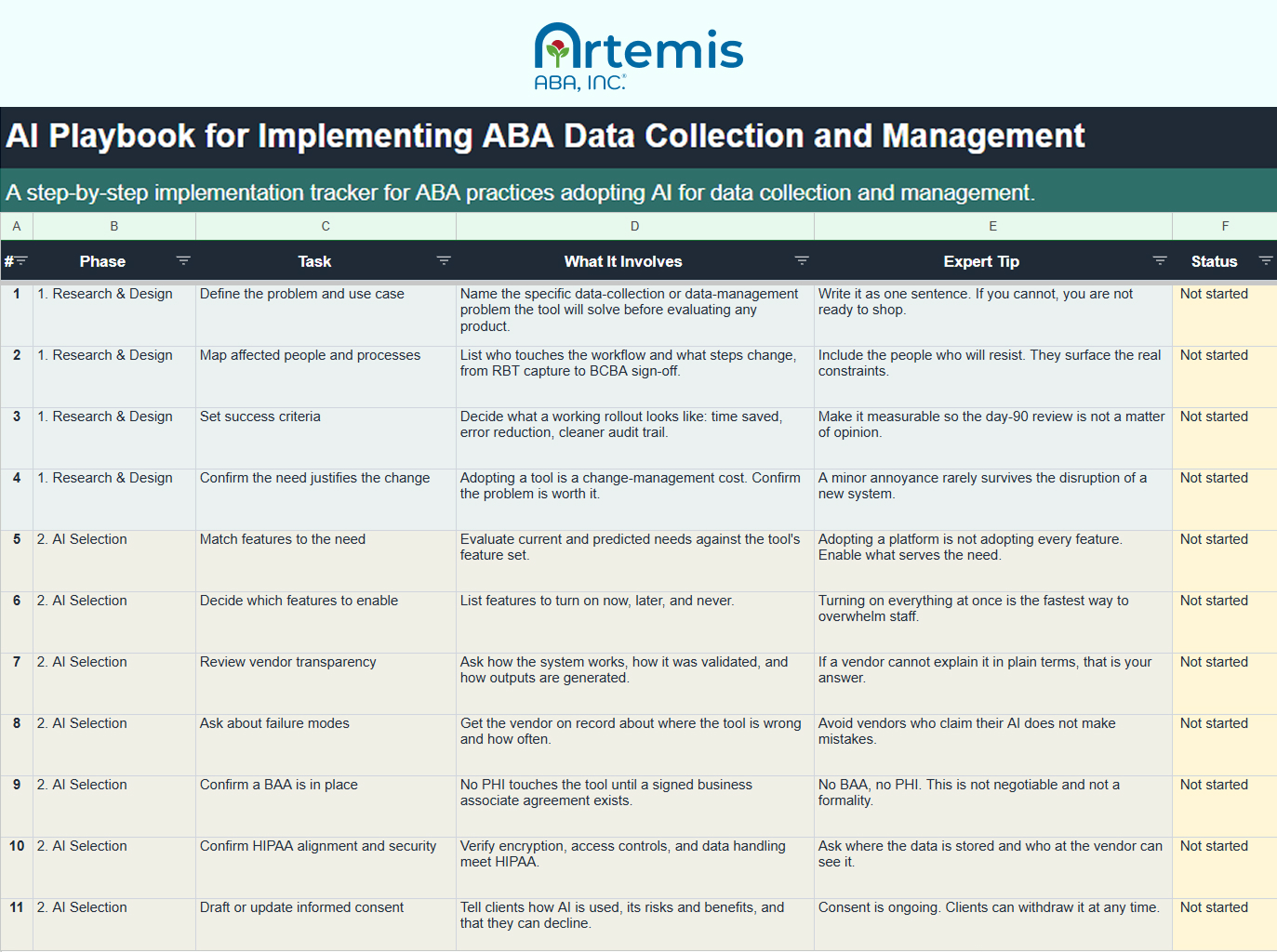
AI Playbook for Implementing ABA Data Collection and Management
The AI Playbook is a downloadable spreadsheet that walks your practice through implementing AI for ABA data, phase by phase. It lists 30 tasks across the AI lifecycle, from selecting a tool to retiring one, with expert tips and columns to track status, owner, and target date.
[fs-toc-omit]How AI Helps to Manage ABA Data Storage, Access, and Audit Trails
AI-based ABA platforms centralize data storage, log access automatically, and keep audit trails that support HIPAA compliance and payer review. The rules do not change. A business associate agreement, the minimum necessary standard, records retention, and, for school programs, FERPA all still apply to any AI tool.
The clearest gain is the audit trail. The HIPAA Security Rule requires audit controls, mechanisms that record and examine activity in systems holding electronic protected health information (45 CFR 164.312(b)). A platform that logs every view and edit meets that automatically. Paper files, loose spreadsheets, and consumer tools do not, which makes scattered data harder to defend in a review. The same access logs support the minimum necessary standard, since role-based permissions control who sees what.
Storage and access remain compliant only if the vendor is under contract. Any AI tool that stores, processes, or transmits client data is a business associate and needs a signed business associate agreement. The 2013 Omnibus Rule made business associates directly liable under HIPAA, and they must hold agreements with any subcontractor that touches protected health information. No agreement means no protected health information in the tool, which is the line general-purpose consumer AI tools usually cross.
Two more rules carry straight into AI workflows. The minimum necessary standard applies the same as any disclosure, so feed the tool only the data the task needs, not the whole record. And retention does not shrink because data is digital. Under BACB Ethics Code standard 2.05, behavior analysts retain and protect documentation in line with all applicable requirements. Standard 2.05 sets no fixed period; the retention period comes from those requirements, commonly seven years or longer depending on state law, funder rules, and organizational policy.
For school-based programs, the governing law may change. Some ABA data collected in schools falls under FERPA rather than, or alongside, HIPAA. If you contract with school districts, confirm which rule governs which records before deciding where AI touches the data, because the storage and access obligations differ.
A proposed update to the HIPAA Security Rule would raise the bar further. It is the first major overhaul of the rule since 2013, and it would make encryption and multi-factor authentication required instead of addressable, the current designation that lets a practice assess and document an alternative rather than implement the safeguard. The proposal is not in force. It was published in early 2025, remains under review, and its expected finalization has already slipped repeatedly. It has been moved to the government's long-term regulatory agenda, with final action now projected for July 2027, and could still change or be withdrawn. A coalition of industry groups has formally asked HHS to withdraw it. Treat it as where the rules are heading, not current law, and confirm its status before relying on it.
Clean, centralized data also pays off outside of privacy law. Session-level records with timestamps and access logs are what support medical necessity when a payer audits your billing. The same audit trail that satisfies HIPAA backs the claims you submit.
[fs-toc-omit]Best Practices for AI in ABA Data Collection and Management
Best practices for AI in ABA data work keep the clinician accountable for every output, protect client data, and disclose AI use openly. Get informed consent, keep protected health information out of any tool without a business associate agreement, and write an organizational policy that defines acceptable use.
These practices apply continuously, not just at rollout. The Ethics Code for Behavior Analysts governs AI use the same as any other professional activity, and the Practice Parameters for Artificial Intelligence Use in Applied Behavior Analysis set the field's implementation expectations. The points below draw on both:
- Keep the human accountable for every output. The Practice Parameters are explicit that AI supports clinical work rather than replacing it, and that the practitioner remains responsible for documentation.
- Disclose how AI is used, and let clients decline. Informed consent should tell clients how AI touches their data, its risks and benefits, and that they can withdraw consent at any time. Offer a non-AI alternative where you can, and disclose AI's contribution in the work products it helps produce.
Coop says she uses a general AI disclaimer in intake paperwork and surfaces it in virtual meetings, and keeps vendor agreements in place. "We have BAAs with all of our in-clinic software and discourage the use of private systems." - Treat privacy as the first risk. The BACB's July 2024 newsletter names privacy as a core risk, warning that information entered into generative AI tools "may be used as learning material for the software and be exported to other users." No protected health information goes into a tool without a signed business associate agreement and organizational approval.
- Govern it as an organization, not case by case. Write an AI policy that delineates acceptable and unacceptable uses, and have supervisors revisit appropriate AI use with BCBAs and RBTs regularly. The RBT Ethics Code 2.0 applies to technicians using these tools, so the standard reaches everyone who touches the data.
- Follow the field's developing guidance. Behavior analysis is building AI guidance beyond any single practice. The Artificial Intelligence Consortium for Applied Behavior Analysis is developing an ethics-first framework for AI use, described in "Behavior Analysis Meets Artificial Intelligence: A Framework Built on Ethics First." Track it alongside the Practice Parameters as expectations tighten.
[fs-toc-omit]Challenges With Using AI for ABA Data Collection and Management
The main challenges of using AI for ABA data are accuracy risks like hallucinations and confabulations, performance drift over time, bias across client groups, privacy exposure with consumer tools, unclear payer coverage, cost, a learning curve, integration gaps, and clinician trust. Most are manageable with oversight.
The Practice Parameters for Artificial Intelligence Use in Applied Behavior Analysis name most of these directly, and practitioner surveys speak to the human ones. Here are the details of the challenges of using AI for data collection and management:
- Hallucinations and confabulations: The Practice Parameters distinguish two failure modes. A hallucination is a factually incorrect, nonsensical, or fabricated output, such as an invented reference. A confabulation is an incorrect reconstruction that fills a gap with similar but wrong information, such as populating a goal template with the wrong target skill. Confabulation is the more dangerous in data work, because a confident, plausible error is easy to sign off on without noticing. This is why a clinician reviews every AI-generated note, summary, or flag before it enters the record.
“One of the biggest mistakes is treating AI as a substitute for clinical review rather than a tool that supports the clinician,” Hatwig says. “Practices can run into problems when staff accept AI-generated content without thoroughly reviewing it for accuracy and completeness.”
She adds: “Many AI systems, particularly those designed for healthcare settings, are intentionally built to avoid fabricating information. As a result, they may leave sections incomplete or require clinician input for critical areas such as treatment planning and clinical recommendations.” - Performance drift: The Practice Parameters define drift as a gradual change in a tool's accuracy or reliability as data patterns, environments, or user behavior move away from the conditions the tool was built for. A system that performs well at launch can degrade quietly, which is why performance is monitored on a set cadence rather than assumed to hold.
- Bias across the clients you serve: AI systems can carry systematic errors that reflect the limits of their training data, and the Practice Parameters note this is nearly impossible to eliminate. Ask vendors to be transparent about their training data and about performance across subgroups, and audit output for fairness across the client populations you actually serve.
- Privacy exposure with the easiest tools: The most accessible option is often the riskiest. General-purpose consumer AI may use whatever you enter as training material, so protected health information cannot go into it without a signed business associate agreement and organizational approval. The storage section above covers the full compliance picture.
- Unclear payer coverage: Most funders do not yet address AI in their ABA policies, so you can't assume reimbursement. If AI touches a billable activity, give the payer a plain description of how you use it before you bill, not after an audit asks.
- Cost and the learning curve: Feature-rich platforms carry a subscription cost and a real ramp-up period before staff are fluent. Budget for the training time, not just the license.
- Integration with the rest of your stack: A tool that does not connect to your other systems pushes the practice back into double entry and manual handoffs, which erases much of the time AI was meant to save. Interoperability with existing billing, scheduling, and record systems is a condition for adoption, not a bonus.
- Clinician trust and adoption: Staff skepticism is a predictable obstacle, and it is not evenly distributed. In "Perceptions of Machine Learning among Therapists Practicing Applied Behavior Analysis: A National Survey," higher certification and more years of experience predicted lower confidence in machine learning's ability to identify behaviors accurately, while prior familiarity predicted greater comfort and trust.
"It Should Support, Not Replace: BCBAs' Perceptions of AI and the Test Content Domains" found a cautious overall stance, with concerns centered on reduced individualization and client confidentiality.
The opposite failure, over-trust, is just as real. Coop warns that "AI cannot know more than what it is fed. The prompts provided can be inaccurate or incomplete, leading to poor results." She points to insurance reviews as the cautionary case: "The system will deny a PAR [prior authorization request] based on key prompts rather than evaluating the whole person/document and drawing clinical conclusions."
[fs-toc-omit]Quiz: Is Your Practice Ready to Use AI for ABA Data?
[fs-toc-omit]Future of ABA Data Collection and Management
The future of ABA data collection and management points toward automated capture moving from research into clinics, new kinds of behavioral data becoming measurable, predictive analytics that recommend rather than display, AI literacy as a required clinical competency, and governance and payer rules that address AI directly.
Each direction below is already underway in the research literature, not just speculation. The pattern is the same across all of them: capability is shown in narrow studies, and the work left is validation, consent, and scale before any of it becomes routine practice.
Automated Data Collection's Future in ABA Clinics
The computer vision and wearable-sensor research covered earlier is beginning to move out of inpatient units and feasibility studies toward everyday clinical validation. The open questions are the ones that keep it research-grade today: whether results hold across broader populations, how consent and privacy are handled for continuous recording, and whether training datasets grow large enough to generalize. When those are answered, automated capture may become standard.

"In 10 years, nobody collects data. The room does," predicts Thomas John, Founder and CEO of Artemis ABA. "A camera and a mic in the therapy space watch and listen to the whole session, the same way an ambient scribe sits in a doctor's visit today. The system sees the trial, hears the prompt and the response, scores it against the plan, tells the BCBA what stalled, and writes it up the way the payer's reviewer reads it. The RBT never touches a tablet."
New Kinds of ABA Data Become Possible
Automated capture doesn’t just change who records the data. It also changes what can be measured at all. Sensors can pick up dimensions a human observer cannot score reliably by eye, such as the force of a dangerous behavior, along with physiological signals like heart rate that rise before a behavior appears. Continuous capture also removes the sampling gaps that interval methods depend on. Together, these open behavioral data that has not been available in routine practice.
"Everything we know today is what a human saw and remembered to write down between trials. That is the weak spot," Thomas John says. "Video and audio fix the first half and a wearable fixes the second. It catches the heart rate climbing before the behavior shows up. Put those together and for the first time you have session data that does not depend on who was in the room or how tired they were.”
He adds, “Long term, the AI models that matter will be trained on ABA session video and audio, not general AI."
Future of Predictive and Prescriptive Analytics for ABA
Today's tools organize data for a clinician to interpret. The next step is models that recommend, not just display. The study "Machine learning determination of applied behavioral analysis treatment plan type" trained a model on 359 patients to classify comprehensive versus focused treatment intensity. Related work extends the same approach to recommending service hours and estimating early prognosis.
All of this is proof-of-concept or model-development work, not clinic-ready tools. Even matured, these models would surface a recommendation for a BCBA to weigh, not make the call.
AI Literacy Will Become a Required BCBA Competency
As these tools spread, the ability to judge them becomes part of the job. The paper "Ethical Behavior Analysis in the Age of Artificial Intelligence" argues that future behavior analysts will need to be AI literate, which calls for changes to education and training programs. A national survey of BCBAs reached the same conclusion, flagging the need to raise AI literacy across the field.
“The clinician reviewing the output must have sufficient competency in data interpretation and documentation to recognize when something is inaccurate,” Hatwig notes. “This is one reason why provider training remains so important. Providers should know how to analyze data and write clinical notes independently before relying on AI tools. Otherwise, errors can easily go unnoticed.”
AI Governance Will Catch Up in ABA
The rules are expected to move from silence toward explicit direction. The Practice Parameters for Artificial Intelligence Use in Applied Behavior Analysis note that most funders do not yet address AI in their ABA policies. That gap is likely to close as adoption grows. Field-level guidance is forming alongside it, with the Artificial Intelligence Consortium for Applied Behavior Analysis building shared ethical standards and the Practice Parameters positioned to iterate as the technology changes.
How Artemis Streamlines AI for ABA Data Collection and Management
The best AI setup for ABA data does the busywork and leaves the clinical calls to you. Practitioners capture, AI drafts and organizes, the BCBA interprets.
Artemis ABA is built on that division of labor with its AI-powered clinical data collection and management. During the session, therapists enter ABC data, preference data, and custom notes from a single screen, so there is no paper to transcribe afterward and no double entry between systems. Artemis instantly generates clean session summaries from those entries, cutting documentation time and the transcription errors that come from rebuilding a note after the fact.
From there, the platform handles the mechanical work while leaving the clinical decisions to the practitioner. Entries sync to a central system, so supervising BCBAs see progress in real time instead of waiting for a weekly export. The mobile app captures data offline during home and low-signal sessions and syncs automatically once the connection returns, so no session is lost. RBTs can pull up skill instructions and a client's behavior intervention plan mid-session, which keeps the reference material in the same place as the data entry.
The human review point stays explicit. Real-time signature capture routes each note to the provider, supervisor, or caregiver for sign-off, so a person reviews every record before it is final. A built-in session clock tracks session time for accurate billing, closing the documentation gaps that create billing errors. AI does the drafting and the organizing. The BCBA keeps the judgment.
To see how it fits your workflow
Schedule Your Walkthrough

Monday to Friday, 7 AM – 7 PM CST.
If you're reaching out outside these hours, please submit a support ticket—our team will respond as soon as possible.




%201.webp)